
The idea for this video was simple. Slightly mean too.
Hand a pro street photographer two “brutal” challenges, drop them into a real city scene, and just watch how they solve problems in real time. Not in a studio. Not with perfect light. Just, you know, Kuala Lumpur doing Kuala Lumpur things.
We shot in the morning, when KL is already awake but still kind of soft around the edges. The light is nicer, the streets are busy without being fully chaotic, and the mix of old shopfronts and glossy towers is right there in your face. You turn one corner and it feels like another decade. Turn again and it feels like the future.
And for this kind of walkaround street session, the Fujifilm X‑M5 (part of the Fujifilm X‑M line) is exactly the type of camera that makes sense. Small body. Unobtrusive. Quick to bring up to your eye. The kind of camera that doesn’t start a conversation before you even take the shot. Which matters more than people admit.
The two challenges were:
- The Merdeka 118 building challenge: three photos, same subject, three different approaches.
- The portrait challenge: approach three strangers and ask to take their photo.
If you’re reading this, you’re going to get more than just “here are the shots.” You’ll get the mindset behind them, the little composition decisions, and a bunch of practical street photography tricks you can steal and use in your own city tomorrow.
For instance, when it comes to approaching strangers for portraits, there are some effective strategies to keep in mind such as how to approach a stranger and ask to take their portrait.
For more insights and stunning visuals from our adventures in Kuala Lumpur, be sure to follow our YouTube channel.
Meet Yoann: a teacher-photographer who hunts “small things” in the street
Yoann introduces himself in the video in the most matter of fact way.
He’s French, from the east of France, and he’s been living in Malaysia since 2020. In Malaysia, he’s a teacher, but also a photographer. That combination makes sense once you hear him talk, because he explains things like someone who has had to break down a thought for other people before.
When asked what he likes to shoot, he says… basically everything. But what he really loves is “all the small things” that people usually don’t pay attention to. And he wants to “sublime” them. Make them feel like something.
That is street photography, at least the good kind.
Not just walking around taking random shots. More like walking, observing, reacting, and pulling a little story out of a moment that most people would walk past. It’s the exact reason street photos can feel alive even when nothing “big” is happening.
And it’s a useful reminder if you’re a gear nerd (I am too). The best street shots usually come from attention, not expensive equipment. The camera helps, sure. But the habit of noticing, that’s the real tool.
Gear talk: why he shoots Fujifilm (and the lenses he reaches for)
Yoann says his favorite brand, the one he actually walks around with, is Fujifilm.
He loves the style and the quality. Which, yeah, is such a Fuji answer, but also a real one. Fuji is one of the few systems where people talk about the experience and the look like it’s part of the camera’s personality, not just specs.
For lenses, he mentions he’s using a 15–55 (a versatile zoom), because for street photography it lets him “play with a lot of things.” That’s the whole advantage of a normal-range zoom in a city. One second you’re wide to show context, the next you’re tighter on a detail, and you’re not swapping lenses while the moment disappears.
He also says he loves the 23mm-ish focal length. That classic street perspective. Wide enough for environment, not so wide that everything looks stretched and empty. And he’s interested in working more with something around 55mm too, which is where you start getting that compression and separation for portraits and tighter layers.
All of this pairs nicely with the whole Fujifilm X‑M5 concept. Small body, low friction setup, practical focal lengths. You can just… shoot. Which is the real goal in street photography. Less thinking about gear, more thinking about what’s in front of you.
Challenge #1: The Building Challenge, 3 photos of Merdeka 118
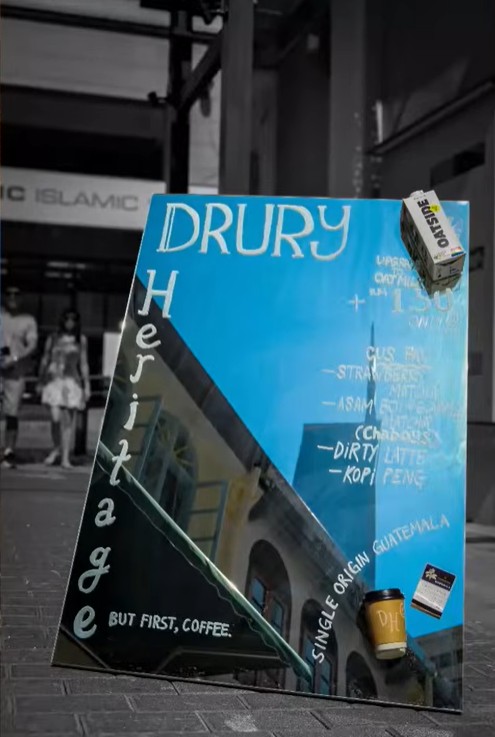
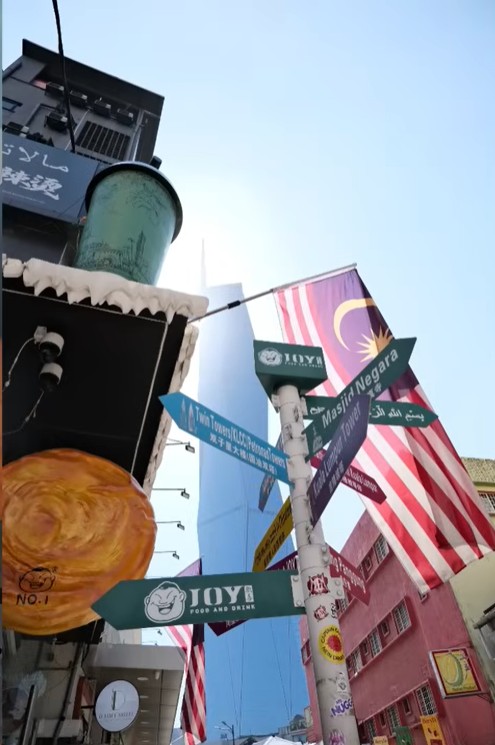
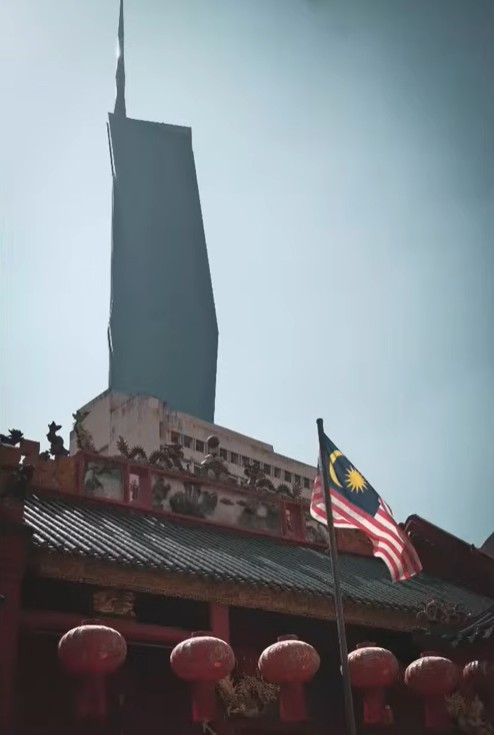
The first challenge is called the building challenge, and the subject is Merdeka 118.
Rule is straightforward: three pictures of the building, but different angles, different framing, different story. Whatever you want, as long as it’s not just the same shot three times.
Creative constraints like this are honestly one of the fastest ways to level up. Same subject, different outcomes. It forces you to stop being lazy with your eyes.
And Merdeka 118 is a perfect subject in KL because it’s such a modern icon, but it sits right near areas that still feel older, like Chinatown. You naturally get that contrast without even trying.
If you’re reading this from another city, you can copy the exact challenge with any landmark. A tower, a bridge, a statue, even a mural. The landmark is just the excuse. The real challenge is variation.
Photo idea 1: hunt reflections and layer a symbol (the Malaysian flag)
Yoann’s first instinct was to look for something happening on the building, not just the building.
He noticed a reflection on the high part of the tower, and he wanted to catch it. But he didn’t stop there. He also saw the Malaysian flag moving in the wind and decided to create a “combo” image, with the tower and the flag together, and he mentions it being in front of the Chinese temple.
So it’s not “here’s a tall building.” It’s layers.
Foreground movement (flag). Background structure (tower). Cultural texture (temple nearby). It immediately feels like place.
Practical takeaway you can copy:
- Scan for reflective surfaces on glass buildings. Don’t just look at the shape.
- Then add a living element. A flag, a bird, a person crossing, even a motorbike blur.
- Build layers on purpose. Foreground plus subject plus context.
Architecture can feel dead if you photograph it dead. Movement fixes that.
Photo idea 2: low-to-high perspective (earth-to-sky) without just shooting the sky
For the second shot, Yoann explains he’s trying another angle, from the earth to the sky, but without “target the sky.” I like how he says it because it’s a common trap. People point up, get a cool tall building, but then half the frame is blank sky. It becomes a brochure photo.
Instead, the trick is to aim upward while still anchoring the frame with street context. Edges, signs, nearby buildings, street clutter, people. Anything that says: this was taken from the ground in a real city, not cropped out of reality.
Composition cues to think about here:
- Use strong vertical lines, but keep them controlled so they don’t feel like they’re falling over.
- Look for leading lines from street corners, poles, building edges.
- Frame the tower with neighboring structures so it feels embedded in the city.
Quick settings guidance (handheld street style):
- Keep shutter speed reasonably fast if you’re shooting upward handheld, because tiny shakes get exaggerated. Something like 1/250 or faster if you can.
- Moderate aperture so the street context stays readable. You don’t need everything tack sharp, but don’t nuke the background either.
- Watch highlights. Bright KL sky plus reflective tower can blow out fast. Expose with a little caution.
Photo idea 3: show Kuala Lumpur’s old vs new mood in one frame
This is the one where Yoann basically gives you the story on a plate.
He says Merdeka Tower is this beautiful modern tower, but it’s in the middle of the oldest Malaysian district, Chinatown. And for him, that contrast represents the mood of the country, old and new together.
He also mentions he likes this corner because it has information, different things to drink, details that immediately communicate where you are. And he says something important. In this picture, you already see the mood and spirit of Kuala Lumpur.
That’s the difference between photographing a building and photographing a city.
Practical takeaway:
- Look for juxtaposition. Old shop signs, temple roofs, street stalls, weathered paint.
- Then place the modern element behind it. Glass, steel, the tower, whatever screams “new.”
- Build a frame that reads like a sentence. Not just a subject.
A “mood shot” isn’t about perfection. It’s about recognition. Someone who knows KL should feel it instantly.
The extra attempt: chasing color contrast (yellow house vs blue sky + tower)
After finishing the three required photos, Yoann asks to try one more.
He remembers a spot where he can create a strong color contrast. A yellow house in front, with the blue sky and the tower behind. Great idea, honestly. That’s the type of shot you pre-visualize and then chase.
But real life does what it does.
He says he’s a bit sad because the sun isn’t his friend. He wanted that beautiful contrast, but he’s fighting the light. He waits a little, tries anyway, and ends up shooting against the light. Not what he planned, but he adapts.
And then he says something that is basically street photography in one line: “I take something else. And I like it also.”
That’s the lesson.
You rarely get the perfect version you imagined. The street gives you options, not guarantees.
Practical takeaway:
- If the light fails, pivot fast.
- Change position. Change your framing. Let it become a silhouette or a flare mood shot.
- Or stop forcing it and move on. The next corner might be better.

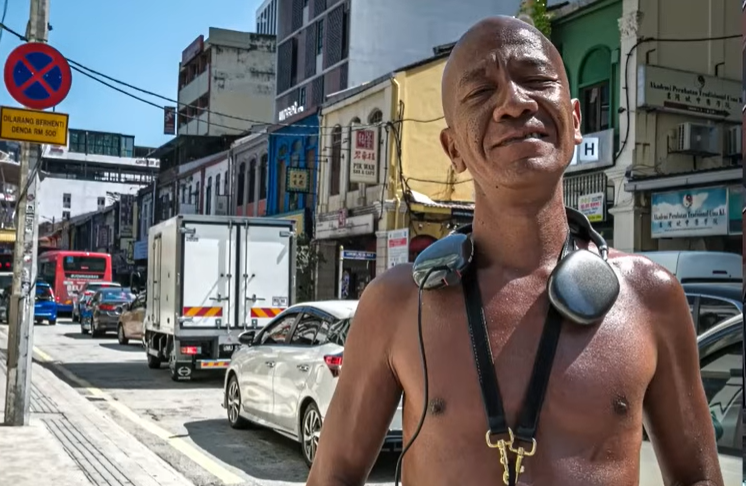
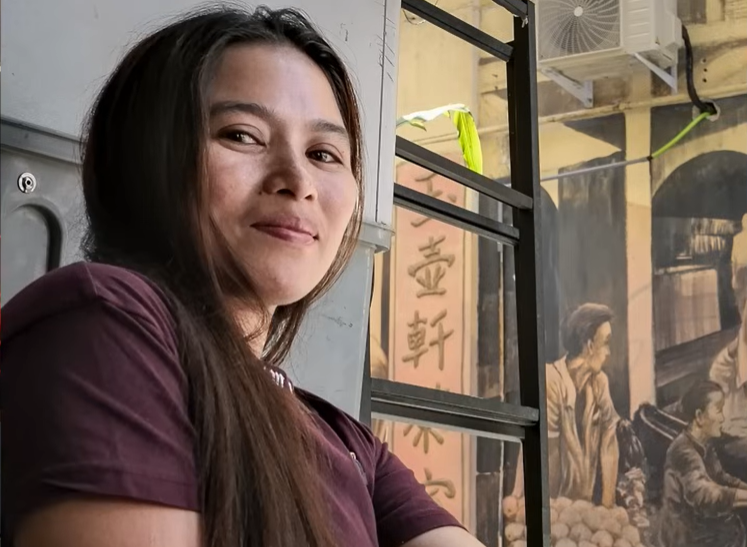
Challenge #2: Approach 3 strangers and ask for their photo (street portraits)
Second challenge is the spicy one.
Find three strangers and ask to take their photo.
It’s “brutal” because it tests confidence and communication way more than camera settings. A lot of photographers can nail exposure in their sleep, but freeze the moment they have to speak to someone.
They talk about how he can explain what they’re doing first so people aren’t scared. Yoann clarifies if it has to be three people together or separate. It can be three different people.
Then they shift location a bit, even going inside, looking for approachable moments.
And the framing here matters. Street portraiture works best when it feels like collaboration, not stealing.
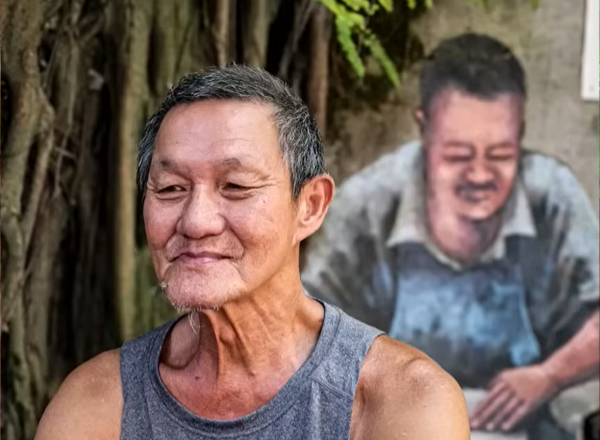
How he approached people: simple, polite, and transparent
Yoann’s approach in the transcript is basically the blueprint.
He keeps it simple. He sees someone and says, in his own words, that he sees a beautiful face and would like to take a picture. He asks politely. He thanks them. He moves on.
With the third person, he even explains the challenge out loud. He says he has a challenge, he has to take pictures of three people in Kuala Lumpur, he already has two, can he take one picture of you? And then thank you, thank you, thank you.
That transparency helps. People relax when they understand what’s going on.
A practical script you can copy (and adapt to your personality):
- “Hi. Sorry to bother you. Can I take a quick portrait of you?”
- “I’m doing a small photo challenge in the city, it’ll take 10 seconds.”
- “Thank you so much, I really appreciate it.”
That’s it. No big pitch. No weird energy.
Also, important even if not shown much. You have to be ready to accept a no with a smile. That’s part of doing this respectfully.
What he learned: discomfort is part of growth (and people are kinder than you think)
After completing the portraits, Yoann says it was very nice. Nice to meet the host, and also, the challenge made him uncomfortable sometimes, especially photographing people.
But he says it was interesting to go out of the comfort zone. That’s where growth happens, unfortunately. There is no shortcut around it.
He also says something that everyone who does street portraits eventually learns: people are so kind.
Not everyone. But enough people. More than you think.
If you’re anxious about approaching strangers, you’re normal. Repetition makes it easier. Start with low-stakes interactions. Ask someone who already looks open. Or someone working at a stall where conversation is natural. Build the muscle.
And portraits will feed back into your whole street photography practice. You start noticing faces, posture, light on skin, emotion, micro stories. It sharpens everything.
What made the shoot work: light, timing, and staying playful
Yoann mentions they were lucky. The weather and light were beautiful that morning, and it made the whole experience more enjoyable.
He also says he’s excited to look at the photos again later and “play a bit” with them. Not obsess in the moment, not over-edit on the street, just shoot first and refine later. That’s a healthy workflow for street. Keep moving, keep your eyes up.
And then the theme that kind of sits under the whole video.
Pleasure, not pressure.
Even with “brutal” challenges, the point is to stay playful. The second it becomes heavy, you stop seeing.
Actionable takeaway:
- Plan around decent light if you can, mornings help.
- Don’t let imperfect conditions stop you. Adapt and keep shooting.
- Keep it fun on purpose. Your photos will look more alive when you are.
Beginner advice from a pro: passion first, perfection later
The last question in the video is what he would say to someone who wants to start photography.
Yoann’s answer is basically the correct answer.
Do it with passion. Photography is art, it’s self-expression, it’s catching the moment. And if you chase the perfect picture, it never happens in reality. You find better results with experience, but you have to try, and enjoy.
He says it clearly: it needs to be a pleasure, not a pressure.
That’s advice people ignore because it sounds soft. But it’s practical. The photographers who get good are the ones who keep showing up.
And a camera like the Fujifilm X‑M5 helps with that, because it’s small enough to be with you more often. Frequency beats theory. Always.
Wrap-up: repeat this Fujifilm X‑M5 street challenge in your own city
If you want to copy this video as a personal photo workout, here’s the whole thing in two lines:
- Landmark challenge: pick one landmark, shoot three different stories of it.
- Portrait challenge: ask three strangers for a quick portrait, politely.
A simple try-it-yourself checklist:
- Pick a landmark in your city.
- Define three variations before you arrive (reflection shot, context shot, mood/juxtaposition shot). This is where understanding photography composition can really help.
- Walk until you find a frame that feels like the place, not just the subject.
- Then approach three people with a simple script, be transparent, be quick, say thank you.
- Go home and review later. Don’t overthink on the street.
When photographing iconic landmarks, remember these 6 tips for taking more interesting photos of them.
And if you’re in Kuala Lumpur, the route is basically built for you already. Merdeka 118 plus the Chinatown contrast, temples, signs, street corners. It’s all there. You just have to show up and look.
Stay curious. Adapt to the light. Keep it fun. That’s the whole game
FAQs (Frequently Asked Questions)
What is the Fujifilm X-M5 street photo challenge in Kuala Lumpur about?
The Fujifilm X-M5 street photo challenge involves handing a professional street photographer two creative challenges in real city conditions of Kuala Lumpur. The photographer captures images using the compact and unobtrusive Fujifilm X-M5 camera, focusing on problem-solving in natural light and authentic urban settings.
Who is Yoann and what is his approach to street photography?
Yoann is a French teacher and photographer living in Malaysia since 2020. He enjoys capturing ‘small things’ in the street—moments or details that people often overlook—and aims to elevate them through his photography. His approach emphasizes observation, reaction, and storytelling rather than random shots.
Why does Yoann prefer using Fujifilm cameras for street photography?
Yoann favors Fujifilm for its unique style, image quality, and the overall shooting experience that feels like part of the camera’s personality. He appreciates the small body and practical focal lengths of models like the Fujifilm X-M5, which allow him to shoot quickly and unobtrusively in street settings.
What lenses does Yoann use for his street photography sessions?
Yoann commonly uses a versatile 15–55mm zoom lens for its flexibility to capture both wide contextual shots and tighter details without changing lenses. He also favors the classic 23mm focal length for its balanced street perspective, and he is interested in exploring lenses around 55mm for portrait compression and subject separation.
What was the first challenge involving Merdeka 118 during the photo session?
The first challenge was to take three distinct photos of the Merdeka 118 building, each with different angles, framing, or storytelling approaches. This exercise encourages creative exploration of the same subject to develop observational skills and avoid repetitive shots.
How can photographers apply these street photography challenges to their own cities?
Photographers can replicate these challenges by selecting a local landmark—such as a tower, bridge, statue, or mural—and creating multiple unique images from different perspectives. This practice enhances creativity, sharpens observation skills, and helps photographers tell diverse stories within their urban environments.

Author: Kl Photoholic
I am Roman Onillon, a professional photographer hailing from France and now based in Kuala Lumpur. My work is focused on elevating photography through a unique perspective and a deep attention to detail that brings life to landscapes, events, and portraits.
Great content! Keep up the good work!